



Smooth Operator
The DEC’s June 3 letter to Cotugno begins with a “thank you.”
“I would like to thank your plant Supervisor, Mr. Kevin McGoldrick, for his time and assistance during my inspection at the facility,” reads the first paragraph.
Immediately afterward, the inspecting agent launches into his findings.
Yet as scathing as its conclusions are, a closer examination of those discoveries—and Cotugno’s answers on how he’s going to fix them—have some legislators and former and current plant personnel scratching their collective heads about exactly what transpired during the “comprehensive facility inspection” the inspecting agent describes in his letter.
The items labeled “Insufficient Preventive Maintenance”—no doubt victims of the gross, systemic lack of preventive maintenance and negligence at Cedar Creek documented in the February legislative report and the Press article in April—are primarily equipment long since broken down, not an engine in need of a simple oil change, for example. If the report were to include a comprehensive list of all the mechanisms deprived of preventive maintenance at the ailing facility, the roster would undoubtedly be volumes thick, just based on the plethora witnessed on the Press’ brief excursions through a fraction of the massive 70-acre complex.
Many of the approximated down times reported are inaccurate, according to Hopper—who is adamant about showing their documentation to regulators and Mangano’s team, and there are many, many pieces of critical equipment in desperate, emergency need of preventive maintenance—or requiring immediate replacement—that the report simply ignores.
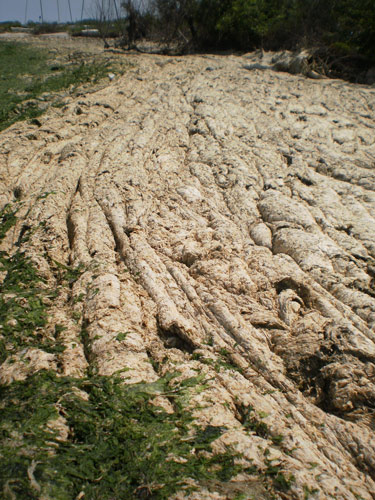
Toxic Seaweed: Outflow of the Bay Park sewage treatment plant has spawned mammoth, 3- to 4-foot-deep swells of seaweed in Point Lookout.
There’s no mention of the scores of inoperative methane gas valves atop the sludge digesters, for example, in the DEC’s report. Nor are the more than 200 non-functioning sludge, water and methane valves dotting Cedar Creek’s vast network of critical pipe work included—despite being clearly marked for emergency repair.
These and many other pieces of dilapidated machinery and broken down processes were observed and photographed by the Press nearly three months ago, around the same time as the DEC inspection. Some, such as several additional primary tanks, for example—where sludges settle and scum is skimmed out—were overloaded with thick layers of grease, floatable contaminants and debris, overrun with solids that should have been removed much earlier in the treatment process. They are literally adjoining units that are included by the DEC. Yet they are not written up.
Neither is the handful of Final Tanks—one of the last stages of treatment before the wastewater is flushed out off Jones Beach—which currently house mini-jungles of 3- to 4-foot-high wild seagrass on their moving scum arms, along with other problems.
Grit Tank Unit # 2, listed on the report as being in need of repair/replacement for seven months, has been in need of critical repairs for more than five years, according to internal memos reviewed by the Press. Hopper, whose voice ranges from heightened, frustrated anguish to resigned despair when speaking of the current situation at Cedar Creek, tells the Press some items listed in the DEC’s report have not received preventive maintenance in more than 15 years, and he’d be happy to show the documentation.
“Oh my goodness,” gasps Tierney of the DEC when informed of some of the apparent discrepancies and omissions. “My general expectation of the plant operator would be that if there’s problems at the plant, they’ve received an unsatisfactory notice, they’re supposed to go in there, do a professional engineering inspection. If you had problem sites like the ones you mentioned, they’re supposed to tell us what’s wrong and how they’re going to fix it. And usually there’s a follow-up.”
“McGoldrick took him to where he wanted to,” blasts Dunne. “McGoldrick’s trying to blame everything on the maintenance crew.”
Cotugno’s “corrective action plan” for fixing the problems that were included in the DEC’s report also leaves room for improvement.
In response to the gross insufficient preventive maintenance, Cotugno replies: “The county endeavors to perform all preventive maintenance as suggested by the equipment manufacturer or supplier, however, at times there might be unavoidable delays but attempts are always made to perform the required work as expeditiously as possible. Equipment failures are continuously addressed so as to minimize any possible detrimental effects to plant performance.”
As reported in the April 29 article, records reviewed by the Press, which Dunne cited more than once during the February hearing before the Legislature, reveal that out of 12,000 estimated man-hours needed for preventive maintenance at Cedar Creek in 2008, eight hours total were accomplished.
Cotugno’s response to the DEC about how he will address the problems with Outflow Pump # 3 defies time and space. He answers that the pump was repaired by a vendor and returned to service March 12.
But the DEC agent’s inspection took place April 7.
“I think that even an 11th or 12th grader could have responded better,” laughs Dunne.
“That won’t get by [DEC Long Island Regional Water Manager] Bill Spitz, I’ll tell you that much,” assures Tierney.
Another of Cotugno’s responses has Corrado Vasquez, a DPW Sewage Treatment Chemist II currently working in the Nassau County Department of Health, livid. Vasquez was the director of Cedar Creek’s state-of-the-art, on-site laboratory, where he and a team of other chemists performed crucial, time-sensitive tests of the sewage and sludge at various stages of its trek through the plant. He worked there for 30 years. Vasquez also monitored Bay Park’s sewage.
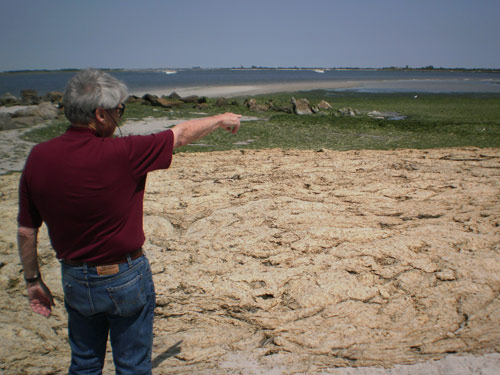
Environmentalist Morris Kramer points out the massive swath’s girth. Kramer has been protecting Long Island’s bays and waterways for more than 45 years.
This past Christmas, he and his team received notification they were being transferred to the health department and would conduct tests on sewage samples transported there from Cedar Creek and Bay Park.
That never happened. Instead, he’s been relegated to health department work and the sewage testing is farmed out to an outside lab while the Creek’s taxpayer-financed, cutting-edge laboratory has slowly been dismantled—its contents stuffed in boxes and littering the skeleton of a stalled, costly, makeshift lab at the health department.
The chemists’ work is so critical because if plant operators don’t react to the findings quickly—say, there are too many metals dissolved here or too many organics there—the plant could pass along pathogens and other contaminants into the environment. It could also fail its State Pollution Discharge Elimination System permit.
Under the new system, the results come back to plant operators more than a week later—or even longer. By then, explains Vasquez, if there were things in the wastewater that weren’t supposed to be, they were long gone—flushed out to the ocean off popular Jones Beach Field Six in the case of Cedar Creek, and into Western Bays from Bay Park.
Here’s how Cotugno justifies the lab’s destruction and sample outsourcing in his July 16 response to the DEC: “The relocation of the existing staff was to enhance their proficiency so that they could become Environmental Laboratory Accreditation Program (ELAP) certified, allowing them to perform the requisite analyses at the Nassau County Health Department laboratories.”
Shown Cotugno’s response, Vasquez is outraged. “Fucking liar! I was certified at Cedar Creek to do that work!” he shouts. “I was the director! There was no need to move us!”


Nassau Sewage System Privatization Could Flush County’s Future Down The Drain
