



In addition, the DEC informs the Press there have been two more wastewater spills at Cedar Creek since “Toxic Time Bomb” ran: 200 gallons on June 29; 25,000 gallons on July 2. The latter—occurring in the newest multi-million-dollar facility financed by taxpayers—resulted in waste discharge exiting the plant’s confines and flowing into nearby storm drains. Both incidents are currently under investigation.
Both incidents went unreported to residents of the surrounding communities.
The DEC’s mandates echo what Terence Hopper, head of plant maintenance at the nearly 40-year-old facility, ominously told the Press three months ago:
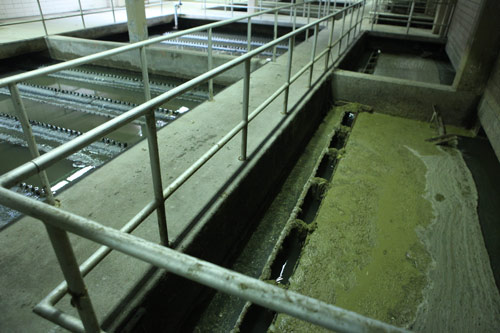
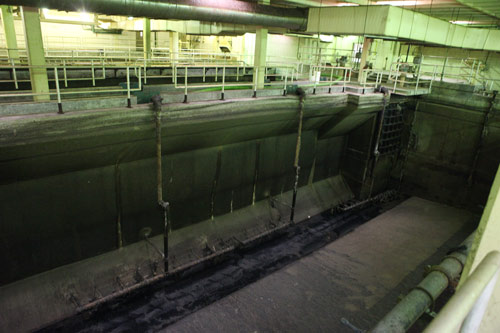
Damage Control: Neglected primary tanks, (below) destroyed grit tanks and (bottom) dilapidated final tanks are just some of the problems plaguing Nassau County’s Cedar Creek Water Pollution Control Plant in Wantagh.
“Every stage of this plant, every section, has failures in one stage or another,” he said. “In my 31 years of experience that I have in the maintenance section, I have never seen this plant as bad as it is.
“Things are catastrophically failing here,” he continued. “It’s not getting better, it’s getting worse. It’s snowballing.”
Hopper, a reluctant whistleblower, feared retribution for speaking out about Cedar Creek’s secrets. Those trepidations unfortunately proved prophetic. For his truth-telling and shining a light on the potential catastrophic hazards rampant at the Creek to save lives, Hopper has received death threats and harassing phone calls, according to a report he filed May 6 with Nassau County police, days after his public airing of the plant’s perils.
Though he didn’t recognize their voices, the father of four believes his tormentors may be workers within the plant worried about losing their overtime pay, should Hopper’s concerns ever be addressed.
“[Because] they’re going to lose money,” he says. “If we have all of the equipment back up and running, there’s no need for them to be working overtime.”
Nassau County Legis. Dennis Dunne (R-Levittown), whose jurisdiction covers Cedar Creek and who has been a vocal force for improvements at the plant for years, explains: “Cotugno was an operations guy, so he takes care of his own guys,” he tells the Press. “So they’re the ones who get all the overtime.”
Yet if detrimental conditions were snowballing then, they’re avalanching now, say Hopper and others. He tells the Press he’s got no choice now but to continue blowing the whistle until the plant gets the manpower, attention and investigation it deserves. Hopper suggests the FBI should visit the plant.
Inoperative methane gas valves are still letting toxic and explosive vapors spew into the surrounding communities at a constant pace. More than 200 valves crucial to much of the plant’s vast network of sludge, water and methane pipes still don’t function properly, despite painted markings long ago designating them for emergency repair work requiring immediate action. Electrical wires continue to twist from beneath unsecured panels across broken-down equipment and dilapidated machinery. Critical equipment, imperative to removing solid wastes and contaminants from the wastewater prior to it being dumped in Jones Beach’s waters, lie in ruins.
Hopper laments that besides three new hires the plant is still roughly 20 employees short of its budgeted proper staffing levels. Now, there’s forklift training and some employees have finally been given federal OSHA- and PESH-mandated, permit-required Confined Space safety training to form a rescue team—life-saving instruction that employees should have arguably always had. He credits them as a response to the latest Press article. Little else has happened, except for more bad news.
The article was “vindication” for NYS Assemblywoman Michelle Schimel (D-Great Neck), who had adamantly fought a proposed diversion of sewage 12 miles from her Great Neck district across Long Island’s aquifer’s “deep-flow recharge area” to Cedar Creek, despite tough pressure from former Nassau County Executive Tom Suozzi’s administration—and DEC Commissioner Pete Grannis, she tells the Press.
The story inspired her to send a May 5 letter to Grannis demanding the reinstatement of an $18 million grant to her district lost by opposing the diversion.
“My community decided against diversion even though we were told by representatives of your agency that we needed to move forward with diversion to Cedar Creek or lose local grant funding, this is unacceptable,” she writes.
“I feel bad for the people who live near Cedar Creek,” Schimel tells the Press. “My heart goes out to them.”
Morale at Cedar Creek has plummeted, Hopper and watchdogs say. Lawmakers still question the fate of millions of dollars in funding they say they approved for necessary repairs, upgrades and additional employees. Crucial machines and processes are still down—allowing large waste solids to continue along the treatment process, further wearing down the system and wreaking destruction to additional equipment.
Rumors abound that the plant will slowly be privatized, in small pieces at first, before being completely taken from public employees’ hands. That worries watchdogs, workers and legislators. Attempts to re-hire recently retired supervisors to head Cedar Creek and Bay Park have been stymied because none contacted want to work under Cotugno, says Dunne. Other veterans are taking advantage of early retirement incentives.
There is no preventive maintenance being done at Cedar Creek, at all, Hopper reiterates to the Press—the equivalent of changing your car engine’s oil, for example—to prevent it from totally breaking down and requiring its costly replacement (though at Cedar Creek, it’s multi-million dollar taxpayer-financed equipment critical to handling 72 million gallons of human waste daily that’s not being maintained or serviced). Employees still don’t have the required, OSHA/PESH-mandated Confined Space Entry training to even enter certain areas to begin repairs.
“This place is in dire need right now,” he warns. “It’s getting worse all the time.”
Cedar Creek’s management team, headed by Cotugno, still has not been replaced, despite the February hearing into its dysfunction by two committees of the Nassau County Legislature, their scathing report to Mangano and emotional calls from legislators, watchdogs, home-owners, even the head of Nassau’s Civil Service Employees Association Local 830, President Jerry Laricchiuta, for a regime change.
And they’re still calling for it.
“They need to restructure the management team at the sewer treatment plant,” explains Laricchiuta. “And until they do that, I don’t think you are going to see any improvement with the workforce in general, the whole attitude, the whole morale, because of the serious problems there with people just feeling like they’re bullied and they’re not trained properly.”

“The time has come to put a new guy in charge and clean the place up, get the maintenance done,” charges Dunne.
The legislator believes part of the problem has been that Shah-Gavnoudias, the DPW’s new commissioner, has been learning about her new responsibilities from the very people who the legislature’s hearings discovered are responsible for the plants’ current shoddy conditions: Cotugno, Davenport and Ribeiro. Until that changes, he says, nothing will improve.
“She saw Cotugno lie to us, but she still relies on Cotugno,” Dunne says. “So Davenport, Cotugno and Ribeiro were the ones telling her, instead of her listening to the community… [and] former workers.
“It’s not fair to us that she had to be broken in by the culprits that got us into this situation,” he continues. “Even a layman can tell you, ‘Hey, if that stuff’s overflowing… something’s wrong.’ C’mon. If you see that the grit tank is empty and it’s been like that since you took the job seven months ago, doesn’t that mean nobody maintains [it], no maintenance guys are down there fixing it? It doesn’t take rocket science, it doesn’t take an engineer to see that.”
But the road to recovery at Cedar Creek would require regulators and county officials get an accurate picture of what exactly needs to be maintained—and what exactly needs to be replaced.


Nassau Sewage System Privatization Could Flush County’s Future Down The Drain
