

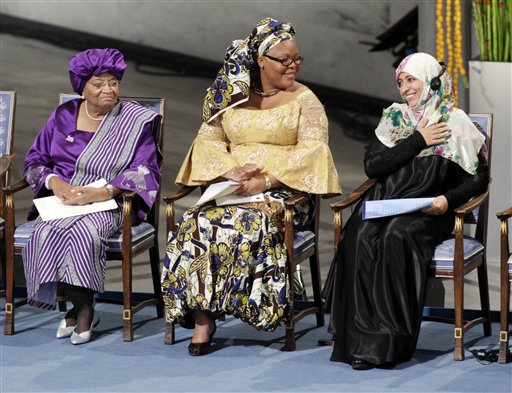

Nobel Peace Prize winners Liberian president Ellen Johnson-Sirleaf, left, Liberian peace activist Leymah Gbowee, center, and Tawakkol Karman of Yemen, right, take the stage at City Hall in in Oslo, Norway Saturday Dec. 10, 2011. (AP Photo/John McConnico)
Three women who fought injustice, dictatorship and sexual violence in Liberia and Yemen accepted the 2011 Nobel Peace Prize on Saturday, calling on repressed women worldwide to rise up against male supremacy.
“My sisters, my daughters, my friends — find your voice,” Liberian President Ellen Johnson Sirleaf said after collecting her Nobel diploma and medal at a ceremony in Oslo.
Sirleaf, Africa’s first democratically elected female president, shared the award with women’s rights campaigner Leymah Gbowee, also from Liberia, and Tawakkul Karman, a female icon of the protest movement in Yemen.
By selecting Karman, the prize committee recognized the Arab Spring movement that has toppled autocratic leaders in North Africa and the Middle East. Praising Karman’s struggle against Yemen’s regime, Nobel committee chairman Thorbjoern Jagland also sent a message to Syria’s leader Bashar Assad, whose crackdown on rebels has killed more than 4,000 people according to U.N. estimates.
“No dictator can in the long run find shelter from this wind of history,” Jagland said. “President Assad in Syria will not be able to resist the people’s demand for freedom of human rights.”
Karman is the first Arab woman to win the prize and at 32 the youngest peace laureate ever. A journalist and founder of the human rights group Women Journalists without Chains, she also is a member of the Islamic party Islah.
Wearing headphones over her Islamic headscarf, she clapped and smiled as she listened to a translation of Jagland’s introductory remarks.
Karman paid tribute to Arab women “without whose hard struggles and quest to win their right in a society dominated by the supremacy of men I wouldn’t be here,” according to an English translation of her acceptance speech in Arabic.
She criticized the “repressive, militarized, corrupt” regime of outgoing President Ali Abdullah Saleh, but also lamented that the revolution in Yemen hasn’t gained as much international attention as the revolts in Egypt, Tunisia, Libya and Syria.
“This should haunt the world’s conscience because it challenges the very idea of fairness and justice,” Karman said.
No woman or sub-Saharan African had won the prize since 2004, when the committee honored Wangari Maathai of Kenya, who mobilized poor women to fight deforestation by planting trees.
Sirleaf, 73, was elected president of Liberia in 2005 and won re-election in October. She is widely credited with helping her country emerge from an especially brutal civil war.
Jagland, the Nobel chairman, noted that she initially supported Charles Taylor but later dissociated herself from the former rebel leader who is now awaiting judgment from the International Criminal Court on charges of war crimes in Sierra Leone.
Gbowee, 39, long campaigned for the rights of women and against rape, challenging Liberia’s warlords. In 2003, she led hundreds of female protesters through Monrovia to demand swift disarmament of fighters, who continued to prey on women, despite a peace deal.
“We used our pains, broken bodies and scarred emotions to confront the injustices and terror of our nation,” she told the Nobel audience in Oslo’s City Hall.
She called the peace prize a recognition of the struggle for women’s rights not only in Yemen and Liberia, but anywhere that women face oppression.
“We must continue to unite in sisterhood to turn our tears into triumph,” Gbowee said. “There is no time to rest until our world achieves wholeness and balance, where all men and women are considered equal and free.”
Last year’s peace prize went to imprisoned Chinese dissident Liu Xiaobo, who was represented by an empty chair at the awards ceremony as an infuriated China would not allow him to travel to Norway.
The other Nobel Prizes — in medicine, chemistry, physics and literature, and the Nobel Memorial Prize in Economic Sciences — were presented by Swedish King Carl XVI Gustaf at a separate ceremony Saturday in Stockholm.
In an emotional moment, Claudia Steinman accepted the Nobel diploma and medal on behalf of her husband, Canadian-born Ralph Steinman, who died of cancer just days before the medicine prize was announced in October. Before sitting down, she blew a kiss toward the ceiling of Stockholm’s Concert Hall.
An exception was made to Nobel rules against posthumous awards because the jury wasn’t aware of Steinman’s death when it tapped him to share the award with American Bruce Beutler and French scientist Jules Hoffman for discoveries about the immune system.
The typically stiff white-tie crowd erupted in cheers when wheelchair-bound Swedish poet Tomas Transtromer, partially paralyzed by a stroke two decades ago, received the Nobel Prize in literature. The 80-year-old had figured in Nobel speculation for so many years that even his countrymen had started to doubt whether he would ever win.
U.S.-born scientists Saul Perlmutter, Brian Schmidt and Adam Riess collected the physics prize for discovering that the universe is expanding at an accelerating pace.
The chemistry award went to Israel’s Dan Shechtman for his discovery of quasicrystals, a mosaic-like chemical structure that researchers previously thought was impossible.
Americans Christopher Sims and Thomas Sargent won the economics prize for describing the cause-and-effect relationship between the economy and government policy.
Worth 10 million kronor ($1.5 million) each, the Nobel Prizes are always handed out on the anniversary of award founder Alfred Nobel’s death in 1896.
__
By: BJOERN H. AMLAND, Associated Press and LOUISE NORDSTROM, Associated Press
Louise Nordstrom reported from Stockholm.
Copyright 2011 The Associated Press.

NY Plaintiff: Gay Benefits ‘Bigger Than Marriage’

Cuomo Takes High Midterm Grades Into Critical Year