

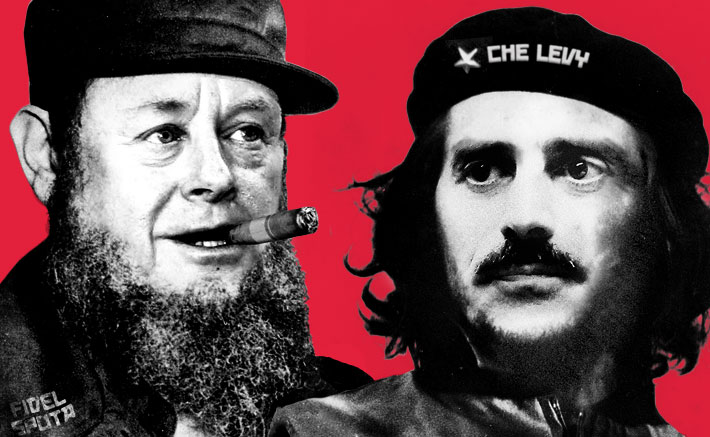

Business partners turned legal adversaries, former Legis. George Guldi (left) and Ethan Ellner, had another thing in common besides their guilty pleas: Their connection to County Executive Steve Levy.
Dialing For Dollars
It’s unlikely that donors to Friends of Steve Levy ever anticipated that the county executive would cut a $35,000 check on March 24—the same day of his fateful announcement—to Long Island’s top criminal defense attorney, Stephen P. Scaring, labeled a “Super Lawyer” by The New York Times. Sources tell the Press that Scaring, a former Nassau County assistant district attorney and chief of that office’s Homicide Bureau from 1969 to 1977, went toe to toe with Spota on Levy’s behalf, and was the one who persuaded the county executive to take the offer. At press time, Scaring was traveling in Europe on vacation and did not return calls for comment left at his Garden City law office. Another criminal defense attorney who did work for Levy earlier this year was Edward Robertson of the St. James law firm of Jakubowski, Robertson, Maffei, Goldsmith & Tartaglia, LLP., which also got $35,000 from Levy’s campaign war chest. Robertson, a former Suffolk assistant district attorney, was seen monitoring the controversial trial of former Suffolk Legis. George Guldi, who’d made no bones about trying to drag the county executive into the courtroom.
Guldi and Levy had done real estate transactions together in the 1990s. A mutual friend, Ethan Ellner, a convicted felon, had pled guilty to his role in a mortgage scam with Guldi and had turned state’s evidence against him.
Guldi, who is now serving time after being found guilty of insurance fraud and grand larceny, was trying to claim that Ellner, whose title search firm had reportedly gotten paid $85,000 in county work thanks to Levy, could link the county executive to a pay-to-play bribery scheme—an allegation the county executive’s spokesmen have said was totally unbelievable.
Levy had been an usher at Ellner’s wedding, and he had rented a garage apartment to Ellner in a house he owned. Spota redacted Levy’s name from court documents and barred Guldi from bringing the county executive into the legal proceedings. After the deal announced on March 24, Guldi, who was sitting in a Riverhead jail cell awaiting the start of an $82 million mortgage fraud that links S&M dominatrices in SoHo to real-estate scams in the Hamptons, said that Levy had just bought a “get-out-of-jail card” for $4.3 million from the Suffolk County district attorney.
Spota’s office had no comment.
“Forget about what caused Spota to seek this, why did Levy agree?” asks Lawrence Kessler, distinguished professor of trial advocacy at Hofstra University’s Law School. “In any type of negotiation leading to a settlement of any kind of legal dispute, no one agrees unless they figure they’re going to lose—if they’re on the defendant side—and no one on the plaintiff side takes less than they wanted unless they think there’s a chance of them not winning. It looks as though whatever this was about must have been serious enough, in terms of Spota’s ability to prove it, that Levy decided it was worthwhile to cut and run.”
The law professor, who’s seen many cases over the years, said that a sealed agreement like this one between Spota and Levy arises far more often in civil case settlements.
“Hiding the details of some transaction which you settle, that’s pretty normal in the American legal system. But the pre-charge settlement of a criminal investigation prosecution—that’s quite unusual.”
Some sources, who declined to go on the record because of their ties to the county executive, thought that Levy had acceded to the deal to keep his wife, Colleen West, from being dragged into the district attorney’s investigation. Others in the know say this theory is poppycock. What has been reported is that five law firms, which got more than $3 million since 2006 from Suffolk County, had hired West’s court reporting transcription service, according to Suffolk records and, according to campaign finance records these five firms contributed $86,950 to Levy. The 1988 Suffolk ethics law would require Levy to report his wife’s work for county vendors, say the lawyers who helped draft the law. But since 2006 the county’s Ethics Commission, whose members are partially appointed or recommended by Levy, allowed Levy to file the New York State financial disclosure form instead of the county form, under the reasoning that since he’s also a member of the state’s Pine Barrens Commission that trumped the county’s requirement.
Citing their legal experts, Levy’s advisors insist to this day that he was right to do this. But one of the attorneys who drafted the county law, Anton Borovina, formerly the counsel for the Suffolk Ethics Commission, says that is “flat-out wrong” and that a state Appellate Court ruling in 2003 reaffirmed that “the county statute trumps the state law.” Comparing the two forms, Borovina says, “The one that is more detailed—the one that requires more from you—is the county form. And it was deliberately designed that way.”
As for Levy’s rationale that he was absolved by his state role, Borovina scoffed, “Come on! The Suffolk County Code of Ethics was intended to apply to county officials and employees: no discretion, no leeway.”
Another plausible explanation floating around in the ether involves Suffolk County’s $156 million construction of a new maximum-security jail in Yaphank, and according to Newsday, contractors and trade unions working on the project gave Levy’s campaign more than $924,000. If the Suffolk district attorney is looking into this, he’s not saying.
And legal experts say that may be by design.
“The plea agreement may prevent the D.A. from disclosing the charges he was planning to investigate against [Levy],” says Barbara Barron, Hofstra Law School professor and a former assistant district attorney in Manhattan who’s an expert on asset forfeiture. “[Levy] may not have to talk about it. What gives him the obligation to tell the public what he did?” She said that if his campaign donors are being refunded, then they, too, are being made whole. “So,” Barron asks, “where’s the harm to the public?”
Where indeed? That’s a question for the voters to ponder.