

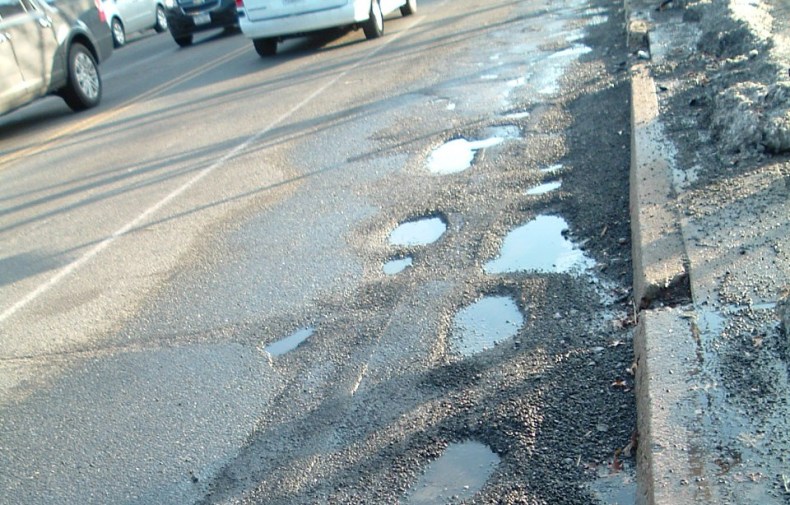

Potholes, like these that pockmark Jackson Avenue in Syosset, have wreaked havoc on Long island drivers.
At the near close of a grueling winter, Long Islanders eagerly embrace the approaching spring, and the warm weather coupled with it. But hold off on the confetti and welcome signs. The forthcoming warm weather also means more potholes.
Despite a snowier than usual January, public works officials in Nassau and Suffolk counties report that report of potholes are about the same as years prior so far this season. Unlike some already depleted snow removal budgets, maintenance crews are not expected to run into the same problem. Yet.
“We generally see potholes around this time right now,” said Shila Shah-Gavnoudias, commissioner of the Nassau County Department of Public Works (DPW). “We will continue to see this through to early spring, but it should die down by April.”
As these pesky potholes continue to plague the grounds of Long Island and its drivers, turning the Island into one colossal crater, they are exasperating—and expensive.
It costs about $480,000 annually for the Nassau DPW to repair potholes.
Since January, the Nassau DPW, which covers about 500 miles of county roadway, received more than 360 complaints and have filled more than 2,400 potholes, is a slight increase over last year.
But many of the complaints were not under the county’s jurisdiction.
“We actually have had more calls this year than last year, to date, but it doesn’t mean that this will persist. If the weather lightens up, it might change,” Shah-Gavnoudias said. “That’s the tough part for someone to understand how to differentiate what is a county road, town road, city road, or village road, and know which road falls under what jurisdiction.”
Gil Anderson, Suffolk’s DPW commissioner, said there have been very few complaints.
“Roughly, up until this past weekend, we’ve had about 30 complaints,” Anderson said. “But it’s still early in the year, even though we’ve had a rough few weeks so far.”
In an attempt at being proactive against potholes, $200 million was put into road improvement for major Suffolk County roads over the past two years, Anderson said. Similarly, Nassau County put in $16 million toward its “aggressive” Resurfacing Program to rehabilitate existing roads.
“You’re never going to eliminate them all together,” Shah-Gavnoudias said. “But, the fewer amounts of cracks in the road, the less chance of potholes,” she said.
Anderson is hoping the weather cooperates. “If we stay above freezing, it may become a moot point,” he said. “If it doesn’t, it could become a big issue. It’s weather dependent.”
He added: “I don’t anticipate it getting much worse, but I’ve been proven wrong before.”
These menaces to motorists form when water, from either the rain or the snow, slips into the cracks and seeps into the dirt and gravel under the road surface. The underground water freezes and expands when the temperature drops, also causing the crack to swell.
When the weather warms up, especially during the end of winter, the water melts, which speeds up the freeze/thaw cycle that weakens the road. It becomes a hole when heavy traffic moves over the weak spots in the road.
As for how long this process takes, it depends on the temperature and weather, said
But how are these pockmarks of the road fixed?
From December through March, once the proper jurisdiction is contacted, multiple crews are sent out within 24 hours to repair the holes by using temporary “cold patches,” usually made from recycled asphalt pavement, to fill them. The debris and excess material are cleaned out of the hole, before the cold or hot mix is poured in. The newly-filled hole is then firmly compacted.
It only takes about 20 minutes to repair one average sized pothole, Shah-Gavnoudias said.
“They are fixed relatively quickly, depending on the size,” said Shah-Gavnoudias, who added that Nassau uses an environmentally-friendly “green patch” that does not contain any petroleum based solvents or cutbacks.
More permanent and deeper road repair is done from April to November.
But could the hole be filled with a different material, like concrete, to further reduce the likelihood of a pothole?
According to Nassau Deputy DPW Commissioner Rocky Maitra, who is also the department’s head of engineering, there are several reasons why concrete would not be a better solution. Although concrete has double the lifespan of asphalt, it is much more expensive and is not necessarily resilient to cracking, he said.
“Concrete will crack much earlier, if the sub-base is not proper,” he said. “Asphalt is flexible and will not crack as early.”
Since the majority of roadways are made with asphalt, concrete would not bond well, he said.
“You can’t fill the pothole with a different material.”
Although current and growing potholes continue to perturb Long Island drivers, there is a silver lining—at least for most auto repair shops, where business is booming.
Randy Williams, owner of J&M Auto Repair in Syosset, recently noticed a massive jump in flat tire service sales.
“Usually, we only get about one tire change per month, and that’s usually from a curb accident,” he says. “But just in one day, we’ve gotten five people for tire changes, rim repairs, and front end alignments.
According to Williams, the cost to purchase a new tire ranges from about $125 to even $500, depending on the car. A new rim would cost a motorist about $250, and just a rim repair sells for $175.
But not only are the amount of customers increasing, the amount of tires being purchased and repaired have gone up tremendously.
“We get a lot of customers every year, but this season has been the worst,” said Craig DelCasino, owner of Traction Plus Discount Tires in Sayville, who added that he’s even seen cars come in with all four tires blown out.
“It’s great for me,” he said. “It’s a business generator. It’s one of those things that are inevitable because of the weather changes.”
But even auto shop owners aren’t immune to the devastating and costly effects of pothole damage.
“I’m making money, but I just lost a rim on my own car,” Williams said. “It’s just horrible. The snow plows are eating up the streets.”
Aware that the approaching spring season and upcoming rise in temperatures create more potholes, Williams braces himself for aftermath.
“You have to be careful out there,” he said. “These potholes are filled with water. You think it’s a puddle and before you know it, you’re in it.”


NY Plaintiff: Gay Benefits ‘Bigger Than Marriage’

Cuomo Takes High Midterm Grades Into Critical Year