

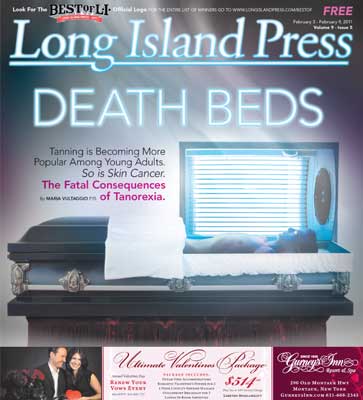
BURNING DOWN THE HOUSE
After losing her daughter to skin cancer at the age of 29, Colette Coyne, of New Hyde Park, learned first hand about the harsh realities of unprotected sun exposure.
“They think ‘It’s not going to happen to me, cancer is for old people,’” says Coyne of young tanners. “But it’s the most common cancer for 15- to 20-year-olds. Our daughter died months after being diagnosed.”
Melanoma ranks 17th as a cancer cause of death in New York State. About 560 New Yorkers die from skin cancer each year, according to the New York State Department of Health, and those numbers have no racial bias.
“Anyone can get melanoma,” Coyne says. “Bob Marley died from melanoma. It started on his toe and spread throughout his body.”
Although a person with dark skin is less likely to get skin cancer, Coyne says they are more likely to die from it.
“African-Americans get it on the soles of their feet and the palms of their hands,” says Coyne. “They think they don’t have to worry. If skin cancer is detected in an African-American individual, it’s usually an advanced case. Their chance of survival is 20 percent less than a Caucasian—their mortality rate is higher.”
Caught early enough, melanoma is often curable. But the risks of excessive tanning are not limited to skin cancer: They also include eye damage, burns and photoaging—premature skin aging due to UV exposure that results in wrinkles, grooves, discoloration, sagging and a leather-like texture of the skin. The Skin Cancer Foundation says up to 90 percent of the visible changes attributed to aging are caused by the sun. Chronic exposure to UV radiation has been shown to accelerate skin aging by up to seven years.
“That is just a price I’m going to have to pay eventually,” says Dammer, the Selden woman who has been tanning numerous times per week since the age of 15. She says she won’t spray-tan because it can look cheap and have an orange tint. “Hopefully somewhere in the near future there will be technology to help with sunspots and wrinkles.”
Some of these changes may appear as early as the age of 20 for those who have spent an excessive amount of time exposed to UV radiation during their childhood and teen years.
Through the Colette Coyne Melanoma Awareness Campaign (CCMAC), named after Coyne’s daughter (also named Colette), Coyne educates middle and high school students on the dangers of tanning. She uses a Derma Scan, a machine that shows damage under the skin.
“You might look at someone’s skin and think it’s beautiful,” she says. “But with the Derma Scan you can see the damage that is not visible to the naked eye. Some kids say, ‘I’ll never use a tanning bed again!’”
Still, a tanorexic may not be deterred by knowing these risks. Some of those with tanorexia have been known to go to such extremes as lying to family, canceling important events or rescheduling them so they can tan.
“I have changed my plans to tan plenty of times,” Keenan admits. “If my friend ever texts me to go tanning, I’ll drop my plans and go with her because I’d rather be tanning, usually.”
Dammer says she would take an appointment as late as midnight to get her “bronzing fix.”
“I feel that at one time I was definitely addicted to tanning and so were my friends,” Dammer admits.
The Wake Forest study also found that 27 percent of those surveyed were tanning-dependent, and the mean age when they started indoor tanning was 17—a terrifying find when exposure to tanning beds before age 35 may increase melanoma risk by 75 percent, according to the Skin Cancer Foundation.
But only tanning now and then won’t do you any favors, either.
“Occasional use of tanning beds almost triples the chances of developing melanoma,” the foundation states.
Even so, in a 2005 survey conducted by Consumer Reports, one out of every three tanning salons denied that tanning could cause skin cancer or would prematurely age the skin.