

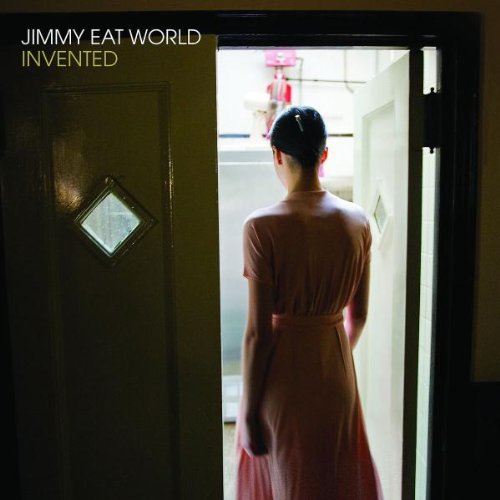
 Jimmy Eat World—Invented (Geffen)
I’ve spent a lot of time thinking about Jimmy Eat World, but I find it impossible to identify them. They’re neither as schmoopy as their detractors would suggest, nor as challenging as their more ardent fans seem to allege. So what the hell are they? At their creative peak—almost universally believed to be their 1999 LP, Clarity—they showcased a peculiar style that bridged the gap between Sunny Day Real Estate and Weezer. But once they hit that sweet spot, they never really returned to it. They followed up Clarity with 2001’s Bleed American, which was re-titled Jimmy Eat World when the terrorist attacks of Sept. 11 apparently made the name Bleed American seem tasteless. Personally, I found the original title to be especially moving in the wake of those attacks. I also absolutely loved that record, which came to be one of my soundtracks of that year; it somehow captured the anger, fear and confusion I felt in that moment.
Structurally, Bleed American dealt in staid pop archetypes: ballads and rockers in equal measure. That was a departure, and arguably a step down, from what the band had accomplished on Clarity, on which each song was both a ballad and a rocker…and something else, too: something drone-y and dreamy and different. Still, Bleed American was a huge commercial success, spawning a few terrific (and ubiquitous) singles. But after that, the band seemed lost: The sound of Clarity had been pushed to its logical end on that album; meanwhile, other bands (e.g., Death Cab For Cutie) had taken a similar formula to levels that Jimmy Eat World wasn’t capable of reaching. However, the pop success the band achieved on Bleed American was equally unrepeatable, and furthermore, threatened to alienate the large core fan base that Jimmy Eat World had established in the years between their 1994 debut and Bleed American.
Ever since then, Jimmy Eat World has seemed like a band without a direction. Futures, the 2004 record that followed Bleed American, was a humorless and often hookless affair; 2007’s Chase This Light seemed like an attempt to bring back the pop audience the band had found on Bleed American and lost on Futures. To be clear, both those records have some very good songs, but neither feels very compelling or complete.
With the new Invented, Jimmy Eat World seem to be trying to recreate that unique chemistry they found on Clarity. I don’t know if that’s an admission of defeat or a newfound comfort in exploring a previously abandoned artistic avenue, but it leads to some exciting, if uneven, results. First, the bad. Frontman Jim Adkins is (still) not a good lyricist: He writes heart-on-sleeve confessionals and relies on his tremendously expressive voice to sell the sentiments. The band still seems to primarily understand music as a binary: This is a heavy song! This is a slow song! (Or, at its most complex: This is a heavy part in a slow song!)
Now, the good: Front to back, these are the best songs Jimmy Eat World have ever written. For all the respect Clarity has garnered, it’s really more stylish than substantial. Bleed American has some absolute gems (“The Middle,” “Sweetness,” “A Praise Chorus,” “The Authority Song”), but it also has some forgettable, embarrassing duds (“Your House” and “If You Don’t, Don’t” are sub-Duncan Sheik soft rock). In particular, the first half of Invented is pretty close to perfect: Lead single “My Best Theory” is kind of what Clarity wants to sound like, mixing IDM and electronic elements with kinetic guitar pop to create a singular hybrid. “Higher Devotion” continues the band’s (surprisingly successful) experiments with Scissor Sisters-esque dance-pop (first evidenced on Chase This Light’s best track, “Here it Goes”). “Movielike” is Adkins’ sad-eyed story about coming to, and being beaten by, New York City—the tale punctuated perfectly by structural choices; it gets bigger and bigger, and culminates in a sweeping and (appropriately) cinematic chorus. “Coffee and Cigarettes” is a nod to Otis Redding’s classic cut of the same name and it may be the simplest, most efficient, effective and greatest song of Jimmy Eat World’s career. It rocks, it’s catchy as hell, it uses Adkins’ magnificent voice to superb effect, it has a nostalgic lyrical thrust with which any listener can identify, and a chorus with which every listener will sing along, scream along, and then hit repeat.
In some ways, Invented puts into perspective the choices made by Jimmy Eat World along the way. It suggests that while the band may have lost their direction at points, they never lost their abilities or their drive. Maybe it’s impossible to identify Jimmy Eat World because they’re still finding their own identity. Invented offers plenty of evidence that the search is worthwhile.


Sonic Boom: What Did I Miss?

Review: Agalloch’s Marrow of the Spirit