



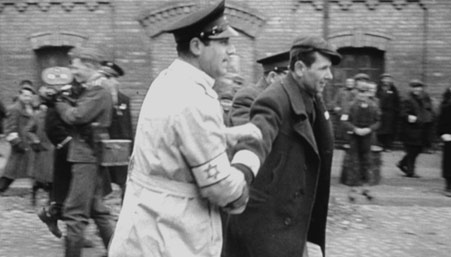
Documentaries about the past pose a real dilemma. Can we ever really know, let alone understand through film, what we never experienced? And are images more reliable evidence, or potentially just as deceptive as the written word? These are ideas I exchanged with Israeli filmmaker Yael Hersonski during a phone interview in connection with her documentary about the Warsaw Ghetto, A Film Unfinished. And while her documentary explores how Nazis manipulated their captured film images for propaganda purposes, questions also linger as to whether any director can be truly objective in conceiving their own framing of events. Not to mention the persistent troubling notion that with the many movies made each year about the Holocaust’s crimes against humanity, lessons never appear to be learned from any of it.
Q: There have been so many films about the Holocaust. What do you feel you bring to the table that’s new and different?
YAEL HERSONSKI: Most of the footage of the Holocaust was filmed by the Nazis, and it lacks personal testimony of the victims. I always felt that there was something beneath the superficial black and white and for myself, I wanted to slow the images down and try to examine the layers of reality that exist beneath what we were educated to see. Or more correctly, what we were educated not to see. But after it was discovered in a vault in 1954, it has only been used in bits and pieces. I wanted to show the entire footage.

Q: Well, your film is unique among Holocaust documentaries in that you probe psychological and not just physical realities.
YH: I do believe that these images bear not only historical content, but an emotional content. I think that was maybe my biggest challenge—how to resurrect those emotions. I felt that every time one of the victims gazed directly into the camera, that they were making a direct contact with me. It doesn’t matter how much a cameraman thinks he can control an image, because within the image, we can see the emotions of people being manifested with expressions in their eyes. That was something I felt I must handle with great care, and to not miss that or have the audience miss those moments. Therefore, I slowed them down, because those moments, for me, were manifestations of the existence of those people. It’s like they are saying with their eyes, “I was really here.”
Q: Is there anything in your own life experience that inspired you to make this documentary?
YH: My grandmother, who lived inside the Warsaw Ghetto, died one year before I began making this film. And she was the one who made it clear to me that there is no way we can really understand this catastrophe, or any other atrocity in this world. Pain is something—maybe the only thing—that one cannot share with others. But I knew that there must be better ways in order to enable me to get closer to understanding what is material that I can touch and what are the experiences I will never understand. But images are much more complex than paper documents. They will forever be open to interpretation. And I think that now, as the witnesses are slowly dying and we will be left with these images, this will be the last testimony. It will be important to understand their importance and value; to approach them critically, and not as if they were just objective documentations of history.
Q: Is your grandmother in that Warsaw Ghetto footage?
YH: I don’t know, I may have seen her, or just imagined it. But it remains an open question.
