



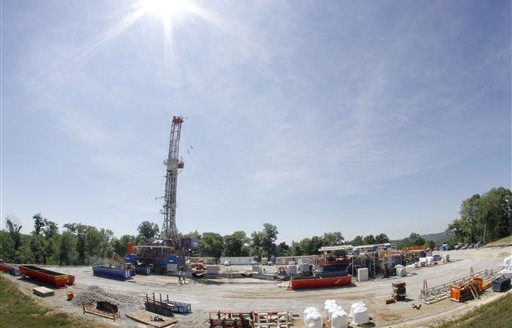

In this July 27, 2011 file photo, the sun shines over a Range Resources well site in Washington, Pa. (AP Photo/Keith Srakocic, File)
After more than four years of environmental review marked by escalating battles between industry and anti-drilling protesters, New York regulators appear likely to complete strict new regulations for shale gas development by the end of February.
But it remains to be seen if drilling actually begins. Gov. Andrew Cuomo and his Department of Environmental Conservation have refused to say whether a 4 1/2 -year moratorium on high-volume hydraulic fracturing, or fracking, will be lifted when regulations are completed. Industry insiders say development will happen slowly if the ban is lifted. And opponents have vowed to escalate protests.
With a depressed natural gas market and threats of lawsuits and civil disobedience from opposition groups, a shale gas boom like that seen in Pennsylvania is unlikely to hit New York if Cuomo gives drillers the green light in 2013.
“My sense of it is, there will be some activity, but I don’t see it as being a big land grab,” said Nancy Schmitt, president of Taum Sauk Capital Management, a New York-based natural resources hedge fund. “I think it’s a smaller resource (than Pennsylvania) and it’s unproven and there’s political risk. There’s a lot of reason to believe they’ll be more cautious moving into New York.”
Tom West, an Albany lawyer who represents Chesapeake Energy and other major drilling firms, said the industry expects DEC to complete the environmental review by mid-February and finalize the regulations by the end of February.
“Then we’ll have to see what the courts say,” West said. “Environmentalists have made it clear that they’ll challenge the standards. If a judge grants an injunction on permitting while their case is pending, we’ll be shut down for another couple of years.”
If there’s no injunction, drillers can apply for permits under the state’s new rules and regulations.
Energy companies have hundreds of thousands of acres under lease in New York. If drilling is allowed, it would most likely start in the Southern Tier counties near the border of Pennsylvania, where the industry has thousands of wells and associated infrastructure. Both states, as well as Ohio and West Virginia, are over the gas-rich Marcellus and Utica shale deposits.
“These are very complex requirements,” West said. “I estimate it will take six months to a year to get permits through the process. Very few wells are likely to be drilled next year.”
Industry opponents say they’re confident Cuomo won’t allow fracking, but if he does, more than 6,000 people have signed a pledge to prevent drilling by staging protests and civil disobedience.
Sandra Steingraber of New Yorkers Against Fracking said opponents are planning numerous events in January, including a rally at the Capitol when Cuomo delivers his state-of-the-state message on Jan. 9.
“Whatever momentum may be moving us toward fracking is not based on science,” Steingraber said. “The governor promised that his decision would be based on science and we intend to hold him to that.”
The DEC has had a moratorium on gas wells using horizontal drilling and high-volume hydraulic fracturing since it began an environmental impact review in July 2008. The technology frees gas by injecting a well with millions of gallons of chemically treated water at high pressure to crack rock deep underground. Environmental groups say it could contaminate air and drinking water supplies, but drillers and the DEC say state regulations and industry safeguards protect against harm.
In September, Environmental Commissioner Joe Martens rejected demands by environmental and health groups to conduct a health impact assessment before finalizing the regulations. Instead, he asked Health Commissioner Nirav Shah to review potential health impacts, with the help of nationally recognized outside experts. DEC had to file for a 90-day extension on its regulations, which had a deadline of Nov. 29, to allow time for Shah’s review.
The agency released revised regulations on Dec. 12 and is taking public comment on them through Jan. 11. The revisions include changes made in response to public comments, such as increased distances between gas wells and residences, allowing for public comment on individual permit applications and stricter disclosure requirements for fracking chemicals.
Further complicating the picture for the industry is that dozens of New York communities have enacted bans or moratoriums on drilling. Judges sided with the towns in two industry challenges of such bans, which the industry claims are invalid based on a state law saying only the state can regulate oil and gas development.
“One question still unanswered is the role local governments will play in this process,” said John Holko, president of Alexander, N.Y.-based Lenape Resources, a well driller. “When you’re spending the kind of capital necessary to develop these resources, you want to minimize risk. You want clear regulatory control.”
Industry appeals of bans in the towns of Middlefield and Dryden are expected to be heard in Albany in February. And Holko and his company have sued the town of Avon over its drilling ban.
The cost of compliance with New York’s regulations will also play a significant role in how willing companies are to invest in drilling in the state, said John Conrad, a geology consultant based in Poughkeepsie. But West said the cost difference between New York and other states has been shrinking as other states beef up their own regulations.
Conrad said some operators may drill a well or two to determine an area’s production potential and then shut in the wells until gas prices are higher. Some of those wells have already been started.
Copyright 2012 The Associated Press.
