
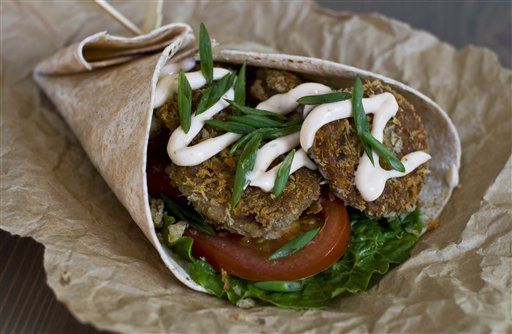

In this image taken on Nov. 26, 2012, a black eyed pea falafel with spicy aioli sauce is shown in Concord, N.H. (AP Photo/Matthew Mead)
Though black-eyed peas have been around forever, they generally don’t get a lot of attention. But I think you really ought to give them a second look.
These peas — which really are a bean — originated in Africa and found their way to ancient India and Asia thousands of years ago. As early as the 5th century people were eating them for good luck on New Year’s Eve. But they didn’t make their way to America until the 18th century, a product of the slave trade.
It was during the Civil War that black-eyed peas became a staple of the Southern diet, as well as token of good luck in the new year in that part of the country. The story goes that as the Union army stormed through the South appropriating crops and livestock as provisions, they turned up their collective nose at black-eyed peas. The troops in blue considered them mere “field peas,” fit for livestock, not people.
In this way, black-eyed peas, paired up with greens, became a dietary staple of the surviving Confederates.
This was, in fact, a stroke of singular good luck. Black-eyed peas are super-nutritious — high in potassium, iron and fiber, and a terrific source of protein. Pair them with greens and you’re looking at an incredibly healthy dish. On New Year’s Eve in the American South, each of those ingredients takes on symbolic value: the peas are coins, the greens are bills. Put some cornbread on the side and you’ve got gold, too.
This recipe is a mash-up not only of a traditional favorite from the American South, but also of one from the Middle East. I’m talking about falafel.
As a New Yorker, I’ve been eating at falafel stands throughout the city my whole life. Typically, the dish is based on ground chickpeas (or sometimes fava beans), combined with tahini (sesame seed paste), and served with a garlicky lemon sauce. Jam these delicious little deep-fried nuggets into a pita with some shredded lettuce and heaven is just a bite away.
My falafel are not deep-fried, but you’re not going to miss it. I create the crust we crave by coating the falafel with panko breadcrumbs, then sauteing them. And I don’t puree all of the peas. I hold some back, then add them to the batter for texture later. I made each falafel “mini” for entertaining purposes, then top them with a light, spicy garlic mayo instead of the usual tahini sauce. The finishing touch is chopped scallions, my nod to the greens part of the original good luck dish.
And, naturally enough, I believe that no matter how or where you celebrate the New Year, this tasty little hybrid will contribute not only to your good luck, but your good health and happiness, too.
___
BLACK-EYED PEA FALAFEL WITH SPICY AIOLI SAUCE
Start to finish: 1 hour 10 minutes (40 minutes active)
Servings: 6 (makes 18 falafel)
4 tablespoons extra-virgin olive oil, divided
1/2 cup finely chopped yellow onion (1 small onion)
1 1/2 teaspoons minced garlic, divided
3/4 teaspoon ground cumin
1/2 teaspoon ground coriander
1/4 teaspoon cayenne pepper
15 1/2-ounce can black-eyed peas
1 large egg
2 tablespoons well-stirred tahini
1/4 teaspoon kosher salt
1/2 cup low-fat mayonnaise
1 teaspoon lemon juice
1/4 to 1/2 teaspoon hot sauce, or to taste
3/4 cup panko breadcrumbs
Chopped scallions, to garnish
In a medium skillet over medium, heat 1 tablespoon of the oil. Add the onion, reduce the heat to moderately low, and cook for 5 minutes, stirring occasionally, or until it has softened. Add 1 teaspoon of the garlic, the cumin, coriander and the cayenne. Cook for 1 minute, then transfer to a medium bowl.
Drain and rinse the black eyed peas. Pulse them in the food processor fitted with the chopping blade just until they are coarsely chopped. Remove 1/2 cup of the chopped black-eyes peas and to the onion mixture.
To the remaining black-eyed peas in the processor, add the egg, tahini and salt. Process until very finely ground, then stir them into the onion mixture. Cover and chill for 30 minutes.
Meanwhile, prepare the spicy aioli.
In a small bowl stir together the mayonnaise, remaining 1/2 teaspoon of garlic and the hot sauce. Set aside.
Once the black-eyed pea mixture has chilled, shape it into 18 patties (the mixture will be loose). Spread out the panko in a pie plate lined with waxed paper or parchment paper, then one at a time dip the patties into it to coat on all sides, lifting the paper on both sides to move them around. Shake off any excess.
In a large non-resistant skillet over medium, heat 2 tablespoons of the remaining oil until hot. Working in batches, add the falafel patties and cook until crisp and golden on one side. Add the remaining 1 tablespoon oil and turn the patties; cook for 3 minutes, or until crisp and golden.
To serve, arrange the falafel patties on a platter and top each with aioli and a sprinkle of scallion.
Nutrition information per serving: 280 calories; 170 calories from fat (61 percent of total calories); 19 g fat (3 g saturated; 0 g trans fats); 35 mg cholesterol; 22 g carbohydrate; 3 g fiber; 2 g sugar; 7 g protein; 610 mg sodium


A Lighter Take on French Onion Soup, Via Italy

Egg and Ricotta Salad: Poached Eggs For Breakfast, Lunch or Dinner