



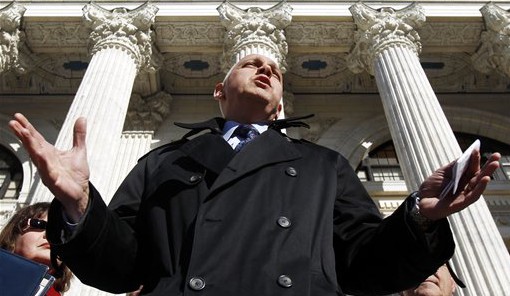

New York State United Teachers President Richard Iannuzzi speaks during a news conference in front of the State Education Building in Albany, N.Y., Monday, Jan. 9, 2012.(AP Photo/Mike Groll)
Most school districts in New York have complied with new state-imposed taxing limits in the budgets they’ll put before voters next month.
For residents, that will mean an average increase in the property tax levy of 2.37 percent. For districts, despite the increase and a bump in state aid, it will mean making do with more than 5,000 fewer teachers and support staff, according to the state’s largest teachers union, which nevertheless supports passage of budgets around the state.
The budgets in the May 15 vote are the first since the state adopted a property tax cap last year that provides a formula to calculate the maximum amount a municipality can increase its levy.
The new law permits schools to increase their property tax levy by 2 percent or the rate of inflation, whichever is less. But there are exemptions like pension costs and capital expenditures that let them go over, so the cap amount varies from district to district. School systems can choose to override the cap but would need a supermajority of 60 percent voter approval to pass a budget instead of a simple majority.
All but 49 of 671 districts decided to work within the cap, according to the New York State Association of School Business Officials. Ten districts are proposing tax decreases and 22 are proposing no increase.
Gov. Andrew Cuomo, who included a 4 percent increase in education aid in the state budget, pushed the property tax cap to slow future growth of rates that are among the highest in the nation.
“For too long, New York homeowners and businesses have been driven from the state by the growing property tax burden, but now that the tax cap is in place we are protecting taxpayers and making our state more attractive for business,” Cuomo told The Associated Press.
With about 40 percent of budgets in, the New York State United Teachers Union had counted a total of 5,368 teaching and support positions lost in this round of plans so far, on top of 30,000 positions eliminated over the past three years, spokesman Carl Korn said.
Even so, NYSUT has begun a $2 million television and radio ad campaign urging the public to approve the budgets as a way to avoid even deeper cuts. If budgets fail twice, districts can’t raise taxes at all from the previous year, under the tax cap law.
“Do you go out and suggest to the community that they vote yes, knowing that they’re going to lose 11.1 of their colleagues as a result?” asked Brunson, a former teacher. “Or do you go out and suggest they vote no, in which case we’ll probably have to reduce that 3.45 percent increase down to something the community will vote yes on, which means more layoffs?”
NYSUT President Richard Iannuzzi called the 0 percent provision for budgets that fail twice “one of the most devastating parts of the tax cap law.”
Traditionally, more than 90 percent of school budgets are adopted the first time around in New York.
Districts say the $805 million increase in state aid does not compensate for a $1.3 billion cut a year ago, or the $1.4 billion cut the year before that, or the flat budget the year before that, although temporary federal stimulus funds helped to soften those blows.
Michael Borges, executive director of NYSASBO, warned that while school districts are largely in compliance with the tax cap this year, it will be harder to do as they deplete reserve funds and run out of non-mandated expenses to cut.
Last year, 251 districts increased taxes by 2 percent or more by passing budgets with a supermajority, according to the New York State School Boards Association.
Associated Press writer Michael Gormley in Albany contributed to this report.
Copyright 2012 The Associated Press.
