

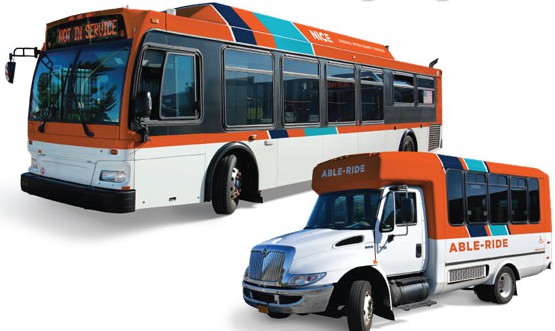

The new look for the proposed Nassau Inter-County Express, or NICE, a public-private partnership county leaders want to take over Long Island Bus on New Years Day, pending legislative approval.
With just six weeks before a controversial public transit privatization plan is set to take hold, the Nassau Legislature postponed a long-awaited public hearing on the multi-million-dollar contract to turn over the county’s bus service to Veolia Transportation, a private company based in Illinois.
Under the proposed contract, Long Island Bus will cease operation with the Metropolitan Transportation Authority—with whom the county had a protracted funding dispute—on Jan. 1 and become the new Nassau Inter-County Express Bus system, or NICE for short, with an uncertain future that could mean fare hikes and service cuts for the 100,000 daily riders.
Last Thursday, County Executive Ed Mangano and incoming NICE Bus chief Michael Setzer unveiled the buses’ new paint job, as well as details of the 300-plus-page contract that they’d been hammering out since June at least.
The legislature’s rules committee was slated to vote on contract Monday as the chamber was filled with a sizeable contingent of Long Island Bus supporters. But after several hours had gone by and the crowd dwindled, Democratic lawmakers complained that they had only then learned of a public hearing on the contract scheduled for Thursday.
The notice was published in a Nov. 7 legal notice, but after some research and debate, Presiding Officer Peter Schmitt (R-Massapequa), conceded the hearing had to be postponed due to a technical error in the language of the legal notice. The hearing will be rescheduled once a new, corrected legal notice is published. The rules committee will reconvene on the contract at a later date as well, he said.
Schmitt let those who remained and wanted to discuss the bus contract, address the members of the committee.
“This contract cedes way too much power to a private company,” said Ryan Lynch, a member of the nonprofit Tri-State Transportation Campaign. It was his understanding that Veolia could eliminate six lines in the first half of 2012 if those lines duplicate other lines a mile away. He said that many Long Island Bus riders “are seniors who may not have the physical capacity to walk a mile in the winter.”
He also singled out a provision in the pending contract that if a “major event” occurs that increases the cost of operations, Veolia can raise fares by 25 percent or cut service by 25 percent. “What exactly is the threshold for a major event?” Lynch asked the legislators. “The language in the contract is not clear.”
For critics, one major event might be the enforcement of a provision in the federal transportation law known colloquially as “13C,” which could obligate the county to maintain comparable wages, pensions and benefits for six years even if the system is run by a private operator.
“Nassau is really on the hook for a lot,” said Jamie Horowitz, a spokesman for the Transit Workers Union, which represents the bus workers.
“13C makes it a whole different ball game,” Legis. Wayne Wink (D-Roslyn) told the Press.
Representatives of Veolia did not speak at the legislature, nor were they available for comment Monday.
Before adjourning for the day, Schmitt assured those who spoke that the committee would not “turn a blind eye” to the questions raised so far. He added, “You can’t expect the county to bankrupt itself.”
He told Lynch that their vision may differ on how to find the best way forward for the bus riders, but “until we go down that road there’ll be no way of knowing who’s right.”
“Whatever we’re going to do here, we’re going to it right… I don’t care if the hearing goes on for 15 hours,” Schmitt said.
It may well last even longer, considering what’s at stake.


NY Plaintiff: Gay Benefits ‘Bigger Than Marriage’

Cuomo Takes High Midterm Grades Into Critical Year