

As the human population continues to grow food will become less and less available. According to The United Nations the human population will approach an astronomical number- seven billion- in 2012! With overpopulation becoming an increasing threat and food sources sure to grow scarce, one man has an idea that could help create food for the ever-growing human population – Vertical Farming.

www.verticalfarm.com
Vertical Farming is the concept that all farming can be achieved at high altitudes within high-rise buildings. These structures will provide food to the mass populations inhabiting the surrounding areas.
Vertical farms could be constructed to offer different food per floor and would be able to provide a vast array of food including most fruits, vegetables and perhaps even coffee beans.
The food would be able to prosper with minimal damage to the environment, unlike horizontal farming; it would not burden our air with fossil fuels (tractors and plows). Vertical farming would use soil free methods of Hydroponic, allowing plants to grow in water, sand or gravel plus a nutrient solution, and Aeroponic, growing plants with a nutrient mist, technologies. The two methods of growth require minimal water due to minimal excessive transpiration. The food would be available year-round with controlled temperatures and would have no weather-related crop failures from droughts or floods.
The idea of Vertical Farming came from Columbia University Professor Dickson Despommier in 1999.
“It actually started in the classroom about 11 years ago with a course called Medical Ecology. It was started with about seven graduate students who, about halfway through this course, got fed up hearing about all of the damage to the environment and health risks that were associated with it. They petitioned me to work on something more uplifting and what they picked was rooftop gardening. They worked on that for about half of a semester, this was in the days before global positioning systems and Google Earth and that sort of thing, so they had to go down to the map room on 42nd street and actually map out how much rooftop area there was in Manhattan. That took quite a while and they had to choose a crop of course and they chose rice because that’s the most energetic crop that we know of and they ended up feeding two percent of Manhattan, which didn’t make them any happier. So I turned to them and said why don’t we take your idea of rooftop gardening and move it inside and put it inside the buildings. There are plenty of abandoned buildings in New York City, always have been, always will be. They seemed to perk up a little bit but that was the last day of class in 1999 and ever since then, the successors of this class have worked on this project,” explained Despommier.
The idea of vertical farming would also benefit our world in ways other than food. For one, it would help slow global warming by allowing forests to grow back where they were destroyed by horizontal farming- where fossil fuel is being exploited by tractors and plows constantly burdening our air. Vertical farming would allow plenty of oxygen back into the air and would allow food to prosper with minimal damage to the environment.
Vertical farming would also allow reduced armed conflict over natural resources such as water and land for agriculture. It would even provide knowledge that we could one day bring to space, if ever humans would visit or dwell there. Economically, vertical farming would be able to stimulate their respective cities economies and provide endless employment opportunities, something we desperately need at this moment.
“If you put it in a larger context of urban agriculture then it’s already changing the future, in fact the future is now. There are a lot of urban agricultural initiatives that are still around New York City; you can see a lot of them in progress if you go to any major city. You can see people working on projects to do with building greenhouses on rooftops. There is one being constructed now in New York City, on the roof of a very large whole foods operation,” said Despommier.
Jennifer Neklin of Gotham Greens is responsible for building a rooftop greenhouse on top of a Manhattan Whole Foods. The nearly four million dollar project will be New York City’s first commercial scale greenhouse farm. It will be 15,000-ft2 of rooftop greenhouse and will aim to produce over 30 tons of vegetables, fruit and culinary herbs. The greenhouse facility is set to begin crop production this year.
“When you see things like that happening, you realize that urban agriculture is a viable alternative to what’s going on now as far as rural agriculture. So it’s are you making a difference, and I think the more of these projects that go up in the next year, the more obvious it will become; if you can control the environment under which you grow your crops, you get a higher much yield,” Despommier said.
Indoor farming creates constant yields. You can keep out insects and use less water. There is little worry about food safety as well, no infectious diseases transmitted by animals and e coli O157:H7. A lot less resources are abused too; no fertilizer all over the soil, instead, you can direct everything to the root systems and the plants grown hydroponically.
Vertical farms were initially an idea for urban centers worldwide like New York City where they will provide plenty of food for the massive populations but the idea doesn’t stop there. A suburban area like Long Island would benefit from indoor farming too.
“You don’t have to go beyond the city limits to find a very densely populated group of people and I think that any apartment complex that’s got a flat roof is a viable candidate for establishing some form of indoor farming on it,” Despommier said.
Economically and environmentally friendly, the idea of indoor farming would allow buildings to save money.
“You get involved with capturing rain water and using it to supply the water sources for these indoor farms and you can start seeing the economics of this play out in terms of saving money for building and not letting the heat escape the roof in the winter time, but be used to maintain growing temperatures for the plants. In the summertime, it would cool it because it wouldn’t be this black tar type roof system that you have now, instead a viable greenhouse. I think greenhouses on top of apartment complexes have a real chance of success. I think you’re going to see a lot of them,” said Despommier.
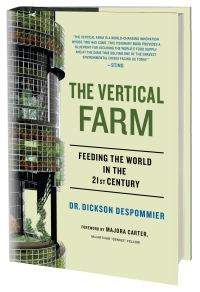
In 2010 Despommier expanded on his idea for New York City to the entire world- He authored a book called The Vertical Farm: Feeding the World in the 21st Century.
“The more I petitioned the students to work on various aspects on the concept of a vertical farm the more I realized there is a larger picture involved and what I was working on mainly and its called an ecological footprint, how much land do people take up in their daily lives over time and how much land someone takes up compared to people in other places,” Despommier said.
The United States has one of the largest ecological footprints in the world following Saudi Arabia who has the largest (But they don’t have as many people so they don’t have as big of an effect on the earth). The United States uses a disproportionate amount of resources, using around 25 to 30 percent of the world’s fossil fuels yet only has about 30 percent of the world’s population.
“Ecologically speaking and evolutionary speaking we are now at a point where we can make a difference in terms of restoring the natural world by using less farm land and in fact giving farmland back to nature and still producing the crops that we have come to accept as normal for our cuisines all of this can be done indoors. I wrote this book to point out what an alternative agricultural strategy might look like if we were to convert to indoor farming,” said Despommier.
Dickson was recently featured in Forbes magazine and was identified as one of the ten people worth watching in 2011. In the past month he traveled to London to speak at a meeting The Economist sponsored in which he explained, “I think they are looking at sort of the next big thing and I think the next big thing is urban agriculture and all of its ramifications.”
Right now, the idea of indoor farming and vertical farming is becoming a reality. In 2010, Brooklyn Grange,a commercial organic farming business located on New York rooftops, began their very first rooftop farm in Queens. The farm is located at 37-18 Northern Boulevard, in Long Island City Queens with almost an acre of rooftop space. There is also a vertical farming plan for the city of Milwaukee by Will Allen of Milwaukee’s Growing Power Inc. Allen has planned a five story vertical farm and has received clearance from the Milwaukee city council. The city of Seattle, Washington has just passed an ordinance, which included in it the language of vertical farming in anticipation of these types of potential farms.
“I am quite proud of my graduate students who contributed to this concept, they are going to live long enough to see their dreams come true,” said Despommier.
Check out this cool Vimeo video of the vertical farms in New York.


A Lighter Take on French Onion Soup, Via Italy

Egg and Ricotta Salad: Poached Eggs For Breakfast, Lunch or Dinner