

The income gap between the richest and poorest Americans grew last year to its widest amount on record as young adults and children in particular struggled to stay afloat in the recession.

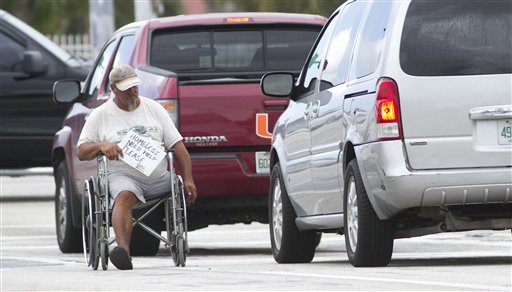
An unidentified disabled man rolls his wheelchair between cars on a Miami exit ramp Thursday, Sept. 16, 2010, displaying a sign that says he is homeless. The ranks of the working-age poor climbed to the highest level since the 1960s as the recession threw millions of people out of work last year, leaving one in seven Americans in poverty. (AP Photo/J Pat Carter)
The top-earning 20 percent of Americans — those making more than $100,000 each year — received 49.4 percent of all income generated in the U.S., compared with the 3.4 percent earned by those below the poverty line, according to newly released census figures. That ratio of 14.5-to-1 was an increase from 13.6 in 2008 and nearly double a low of 7.69 in 1968.
A different measure, the international Gini index, found U.S. income inequality at its highest level since the Census Bureau began tracking household income in 1967. The U.S. also has the greatest disparity among Western industrialized nations.
At the top, the wealthiest 5 percent of Americans, who earn more than $180,000, added slightly to their annual incomes last year, census data show. Families at the $50,000 median level slipped lower.
“Income inequality is rising, and if we took into account tax data, it would be even more,” said Timothy Smeeding, a University of Wisconsin-Madison professor who specializes in poverty. “More than other countries, we have a very unequal income distribution where compensation goes to the top in a winner-takes-all economy.”
Lower-skilled adults ages 18 to 34 had the largest jumps in poverty last year as employers kept or hired older workers for the dwindling jobs available, Smeeding said. The declining economic fortunes have caused many unemployed young Americans to double-up in housing with parents, friends and loved ones, with potential problems for the labor market if they don’t get needed training for future jobs, he said.
Rea Hederman Jr., a senior policy analyst at The Heritage Foundation, a conservative think tank, agreed that census data show families of all income levels had tepid earnings in 2009, with poorer Americans taking a larger hit. “It’s certainly going to take a while for people to recover,” he said.
The findings are part of a broad array of U.S. census data being released this month that highlight the far-reaching impact of the recent economic meltdown. The effects have ranged from near-historic declines in U.S. mobility and birth rates to delayed marriage and the first drop in the number of illegal immigrants in two decades.
The census figures also come amid heated political debate in the run-up to the Nov. 2 elections over whether Congress should extend expiring Bush-era tax cuts. President Barack Obama wants to extend the tax cuts for individuals making less than $200,000 and joint filers making less than $250,000; Republicans are pushing for tax cuts for everyone, including wealthy Americans.
The 2009 census tabulations, which are based on pre-tax income and exclude capital gains, are adjusted for household size where data are available. Prior analyses of after-tax income made by the wealthiest 1 percent compared to middle- and low-income Americans have also pointed to a widening inequality gap, but only reflect U.S. data as of 2007.
Among the 2009 findings:
—The poorest poor are at record highs. The share of Americans below half the poverty line — $10,977 for a family of four — rose from 5.7 percent in 2008 to 6.3 percent. It was the highest level since the government began tracking that group in 1975.
—The poverty gap between young and old has doubled since 2000, due partly to the strength of Social Security in helping buoy Americans 65 and over. Child poverty is now 21 percent compared with 9 percent for older Americans. In 2000, when child poverty was at 16 percent, elderly poverty stood at 10 percent.
—Safety nets are helping fill health gaps. The percentage of children covered by government-sponsored health insurance such as Medicaid and the Children’s Health Insurance Program jumped to 37 percent, or 27.6 million, from 24 percent in 2000. That helped offset steady losses in employer-sponsored insurance.
The 2009 poverty level was set at $21,954 for a family of four, based on an official government calculation that includes only cash income. It excludes noncash aid such as food stamps.
Arloc Sherman, a senior researcher at the left-leaning Center on Budget and Policy Priorities, noted the effects of expanded government programs in cushioning the impact of skyrocketing unemployment. For example, the Census Bureau estimates that 3.6 million people would have been lifted above the poverty line if food stamps were counted — a number that would have reduced the 2009 poverty rate from the official 14.3 percent to 13.2 percent.
Sheldon Danziger, a University of Michigan public policy professor, said while the U.S. has developed policies to combat poverty, it has trouble addressing ever-widening income inequality — even with a growing federal deficit and previous warnings by former Federal Reserve Chairman Alan Greenspan about soaring executive pay.
An Associated Press-GfK Poll this month found that by 54 percent to 44 percent, most Americans support raising taxes on the highest U.S. earners. Still, many congressional Democrats have expressed wariness about provoking the 44 percent minority so close to Election Day.
“We’re pretty good about not talking about income inequality,” Danziger said.
___
Online: www.census.gov
By HOPE YEN,Associated Press Writer
Copyright 2010 The Associated Press.


NY Plaintiff: Gay Benefits ‘Bigger Than Marriage’

Cuomo Takes High Midterm Grades Into Critical Year